
 Authorization
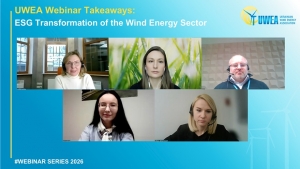
The Ukrainian Wind Energy Association (UWEA) launched its 2026 webinar series with an event dedicated to one of the most pressing topics for the sector: the implementation of Environmental, Social, and Governance (ESG) principles. The event, titled “ESG in Wind Energy Projects: From Theory to Financing,” brought together leading market players for an expert discussion on how global sustainability standards are becoming the foundation for the development of the Ukrainian energy industry. The event was moderated by Yaroslav Petrov, Partner at Asters Law Firm, who set the tone for the discussion by emphasizing the irreversible changes in the rules of the game within the capital market.
Marta Halabala, Counsel at Asters, outlined the legal dimensions of the issue. She warned developers against a lighthearted approach to the new requirements, highlighting the direct correlation between non-financial indicators and project economics. “Today, ignoring ESG factors poses direct financial threats to business. It is not only a risk of being denied credit but also entails a significantly higher cost of capital due to the so-called ‘risk premium’ ESG is increasingly becoming a critical tool for assessing risk and the long-term sustainability of a business,” the expert noted.
The banking sector’s perspective was presented by Svitlana Semenovych, Head of the ESG Implementation Office at JSC UKREXIMBANK, who detailed the difference between mandatory and voluntary assessment criteria. According to her, banks clearly distinguish between ESS and ESG concepts. “Environmental and Social Standards are our mandatory requirements—a kind of ‘admission filter’ for financing. At this stage, we analyze real physical and legal risks: whether the land-use designation has been changed, easements and access roads are properly documented, and if there are conflicts with local communities. ESG, on the other hand, is a broader tool for assessing the overall maturity of the company, which directly affects the cost of money. However, without compliance with basic ESS standards, the conversation about project financing will not even begin,” explained Svitlana Semenovych.
Iryna Bernatska, Director of Fenix Repower Ukraine, continued on how these standards influence investment attractiveness. She emphasized that for international partners, the acronym ESG is synonymous with reliability. “For a foreign investor, ESG equals risk management and project value protection. The quality of documentation, especially the Environmental Impact Assessment report, is critical: we value not just the formal presence of paperwork, but the actual depth of research, including biodiversity impact assessments and consideration of cumulative effects. It is a project's compliance with ESG criteria that determines its bankability and significantly accelerates the closing of financial deals,” the speaker underscored.
The practical side of the environmental component was addressed by Mariia Lopushanska, an ecologist at the Eco-Optima Group. She advised businesses to move from theory to concrete steps. “ESG is not about aesthetic reporting or mere figures; first and foremost, it is a tool for project risk management. The implementation of ESG should begin with an honest internal audit and the systematization of a company’s existing data. The environmental aspect of this transformation extends far beyond the popular topic of greenhouse gas emissions reduction. It is a painstaking daily process of identifying all constraints at the project planning stage – ranging from sanitary protection zones to considering coastal protection strips of water bodies, habitats of Emerald Network sites, nature reserves, and avian migration routes.” Ms. Lopushanska summarized.
The webinar highlighted a key conclusion: in the context of active integration into the European framework, compliance with the principles of transparency, environmental, and social responsibility has become an imperative for the Ukrainian wind energy sector, determining its very ability to exist and thrive in the market.

 Home
Home