
 Authorization
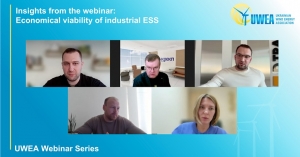
On 03 November 2025, the UWEA held the second webinar in its series dedicated to Energy Storage Systems (ESS) - a technology that is rapidly gaining momentum in Ukraine. While the first event focused on the legal foundations for launching ESS projects, this session shifted towards economic feasibility, investment attractiveness, and regulatory practices in the market. By sharing their practical experience, speakers demonstrated that within just a few years, ESS could evolve from being a technological supplement into a full-fledged driver of profitability in Ukraine’s electricity market. Particularly so, if the three main pillars of commercial activity in this field remain: financial efficiency (from accurate ROI calculation to the optimal power-to-capacity ratio), effective profitability strategy (choosing between arbitrage on DAM/IDM markets, participation in ancillary services, or hybrid project models), and a favourable regulatory environment (ensuring proper licensing, defining the status of active consumers, and establishing solid legal frameworks).
The event was moderated by Ihor Retivov, Partner at Altelaw & Sempra and Head of the UWEA Committee on Energy Storage Development. Invited speakers included:
Opening the discussion, Mr. Ostapiuk, whose presentation focused on possible models of ESS deployment and connection specifics for different market participants, emphasized that “the role ESS play today in primary and secondary regulation cannot be overestimated. Energy storage is one of those tools that can significantly ease the ‘breathing’ of our energy system and ensure uninterrupted power supply.”
Next, Mr. Zakharchenko, who heads the division managing over 250 MW of ESS (Energy Storage Systems), focused on commercial issues and financial-economic modeling based on the project type: whether it is a project without a long-term contract and fixed income, where the profit level depends on the trading strategy of the optimizer/aggregator, or a project involving cooperation with NPC Ukrenergo through long-term auctions. “If we are discussing the Frequency Restoration Reserve (FRR), then depending on the scenario and operational profile, our experience shows an IRR of 23% to 28% for such projects. Anything outside this range usually indicates either overly optimistic calculations or the failure to account for important parameters”, noted Yehor Zakharchenko. Overall, the D.TRADING representative remarked that a “professional commercial strategy is always a mix of different profitability models. There is no universal formula. Each project requires its own approach that considers market risks, technical capabilities, and regulatory frameworks.”
Continuing the webinar, Serhii Kravchuk explored both the broader philosophical questions of ESS installation and more specialized topics—such as the possibility of using a single ESS across different market segments and the specifics of managing ESS using EMS (Energy Management Systems), using the software solution developed by KNESS as an example. The future of the industry lies in the combination of generation, storage, and digital management. Such solutions are precisely what enable the creation of flexible, cost-effective, new-generation energy systems. “An EMS system analyzes the market in real-time, forecasts loads, and automatically makes decisions on when to sell, when to charge, and when to support the grid,” Mr. Kravchuk explained.
Finally, Maryna Ilchuk focused on the legal aspects of active consumers' activities, including cases where they install ESS, and the mechanisms for regulating relationships between the active consumer, the TSO/DSO, third parties (suppliers), and aggregators. An active consumer with their own energy storage system can not only optimize their own consumption but also enter the market as an independent player, providing flexibility to the system and generating additional income. “Today, the legal field is gradually catching up with the market's technological dynamics. It is crucial to provide legislative clarity regarding the status of the active consumer, as well as the status of electricity producers who have installed ESS,” Ms. Ilchuk noted.
Thus, ESS are becoming the key link between renewable generation, consumption, and system flexibility, while also opening a new investment segment for businesses.
UWEA extends its sincere gratitude to all speakers for their professionalism and willingness to share their expertise, and to all participants for their active engagement and insightful questions.
Energy storage represents a new level of thinking in the development of Ukraine’s electricity market - and it is precisely such discussions that help transform ideas into tangible action.
Speaker materials are available at the following link: https://drive.google.com/drive/folders/1iK0iCoYJVbKk6gTFxVUB2VAFNHSmfqUN?usp=share_link
The webinar recording is available on the UWEA YouTube channel.

 Home
Home