
 Authorization
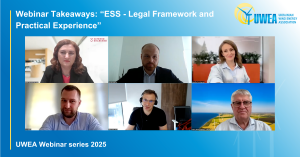
In the face of unprecedented challenges confronting Ukraine’s power system, the flexibility, stability, and resilience of the grid have transformed from technical requirements into a matter of energy security. Energy Storage Systems (ESS) are one of the key technologies capable of solving these challenges. In response to a pressing market need, the UWEA has launched a new webinar series designed to be a practical guide for everyone interested in developing energy storage projects.
The first event in the series, which took place on 07 August 2025, brought together leading industry experts who provided a detailed examination of both the specifics of integrating ESS with existing RES facilities and the nuances of implementing standalone projects. Special attention was paid to long-term aspects that determine reliability and profitability, particularly the key terms of Long-Term Service Agreements and the warranty obligations of integrators. The webinar served as a platform for exchanging not only theoretical knowledge but also practical experience, which is crucial for the market’s development today.
The discussion began with a fundamental question: where to start development and what is the legal framework for such projects today. Natalia Khmelovska broke down the initial steps for investors.
Natalia Khmelovska, a lawyer in the energy practice at the Sayenko Kharenko law firm: “The regulator has already adapted the Licensing Conditions for business activities in energy storage to the specifics of ESS – in particular, by clarifying the list of required documents depending on whether the installation is classified as immovable or movable property. However, in practice, challenges remain regarding the processing of permits and the resolution of land-related issues. These very aspects demand heightened attention during the development stage.”
Next, the focus shifted to the practical aspects of integrating storage systems with existing RES facilities. Natalia Korobenko shared her experience and the regulatory specifics that producers need to consider.
Natalia Korobenko, Regulatory Affairs Manager, Elementum Energy, Deputy Head of the UWEA Legal Committee: “Tremendous work has recently been done to amend the legislative and regulatory acts governing the installation and operation of energy storage systems. Yes, certain gaps and provisions still require further refinement. However, a regulatory foundation has already been established today that paves the way for the implementation of even more energy storage projects in Ukraine.”
After discussing integration with RES, the participants moved on to the specifics of implementing ESS projects as separate, independent facilities. Sergiy Kravchuk explained the difference in approaches to developing such systems.
Sergiy Kravchuk, Director, KNESS Energy, Deputy Head of the UWEA Committee for ESS Development and Implementation: “Today, we can confidently state that ESS projects in Ukraine have moved from theory to practice. There are clear legal models that allow for flexible integration of ESS – whether within a producer’s “green tariff” framework to optimize imbalances, or as a full-fledged “standalone” market participant that only needs a generation license. And although the implementation process is complex, from land development to acquiring market participant status, the economic model is absolutely compelling: price arbitrage strategies on the DAM combined with operations on the balancing market reduce the payback period and prove that ESS is no longer a hypothetical possibility, but a critically important and economically viable investment.”
To conclude the webinar, Vadym Utkin drew attention to a critically important aspect for the long-term success of any ESS project – equipment reliability and service.
Vadym Utkin, Advisor to the CEO, DTEK Renewables: “A Long-Term Service Agreement is essentially your insurance policy. It is very important to pay attention to indicators such as Round Trip Efficiency, which is the efficiency of the charge-discharge cycle, and Availability of the unit. These parameters, specified in the contract, will determine how much money you earn. It is also necessary to understand that the battery degradation warranty is one of the key elements that affects the project's economics for the next 10-15 years.”
The full recording of the webinar can be viewed at the link:
https://youtu.be/1tJlxMfa1A0?si=xX2Q4Vyuk5sZzDGU
The speakers’ presentations are available at the link:
https://drive.google.com/drive/folders/1g8dpLMhvdd96Rw8sBb0U5H_UnkrJvFSQ?usp=share_link
This webinar was the first in a planned series of events, aimed at creating a comprehensive platform for knowledge exchange and promoting the accelerated deployment of the ESS market in Ukraine.

 Home
Home