
 Authorization
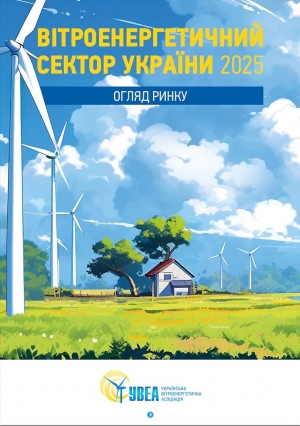
The UWEA is pleased to announce the release of its annual Market Overview “Ukrainian Wind Power Sector 2025” - a comprehensive analytical report that not only summarizes the key developments of the industry over the past year, but also captures the deeper structural transformation of Ukraine’s entire energy sector under the conditions of a full-scale war.
This year’s Overview was prepared in cooperation with UWEA member law firms Sayenko Kharenko and CMS.
A distinctive feature of the Overview is the inclusion of expert columns from representatives of key public institutions directly shaping Ukraine’s energy policy. In particular, the report features a contribution from Artem Nekrasov, First Deputy Minister of Energy of Ukraine, focusing on the development of distributed generation. The transformation of state support mechanisms is addressed in a column by Vladyslav Novikov, Acting CEO of the SE Guaranteed Buyer, who provides a detailed analysis of support auctions and outlines the next steps for improving the model. In addition, Ruslan Slobodyan, Member of the NEURC, contributes an expert perspective on the development of Ukraine’s national system of Guarantees of Origin.
The Overview is further enriched by contributions from UWEA member companies, including DTEK Renewables, Elementum Energy, Friendly Wind Technology LLC, ETG.UA, Eco Optima, Altelaw & Sempra, and LCF, whose practical experience provides real-world insights into project development, investment decisions, and evolving business models.
The scientific dimension of the publication is provided by the Institute of General Energy of the National Academy of Sciences of Ukraine, an UWEA partner, which contributed exclusive research on integrating wind power plants into hybrid energy systems with energy storage.
Additional analytical depth was provided by Exploration & Production Consulting (EXPRO), offering detailed insights into market trends, statistics, and cross-border electricity flows. This integrated approach, combining public sector vision, private sector expertise, and scientific research, positions the Overview as a platform for shaping a shared vision of Ukraine’s energy future.
A key highlight of this year’s publication is the announcement of Energy Storage Day 2026, to be held on April 27, 2026, in Kyiv - a dedicated industry conference focused on energy storage technologies, renewables, and the development of a decentralized energy system in Ukraine.
Key analytical insights from the Overview include:
“Total installed wind capacity has reached 2.2 GW (including 1.3 GW located in temporarily occupied territories), indicating that the sector has achieved critical mass — with preserved supply chains, local contractors, engineering and service teams, and institutional experience in delivering large-scale projects,” stated in the foreword by the Chairman of the UWEA Board.

 Home
Home