On June 18–19, 2026, the 10th International Forum of Agrarian Innovations “Nove Zernyatko 2026” took place in the village of Nastasiv, Ternopil region, bringing together over 150 partners and 9,000 visitors. One of the key events of the forum was the thematic panel “Innovations in Energy: Challenges and Opportunities during the War in Synergy with Ukraine’s Agricultural Potential.” Representing the Ukrainian Wind Energy Association (UWEA) in the discussion was Mykola Savchuk, Deputy Chairman of the UWEA Board for Distributed Generation and CEO of GRESA-GROUP. The energy panel was moderated by Serhii Savchuk, Member of the Board of the Bioenergy Association of Ukraine. The speakers included Andrii Herus, Chairman of the Verkhovna Rada Committee on Energy and Housing and Utilities Services, Vladyslav Stemkovskyi, Deputy Mayor of Ternopil, and heads of specialized energy companies.
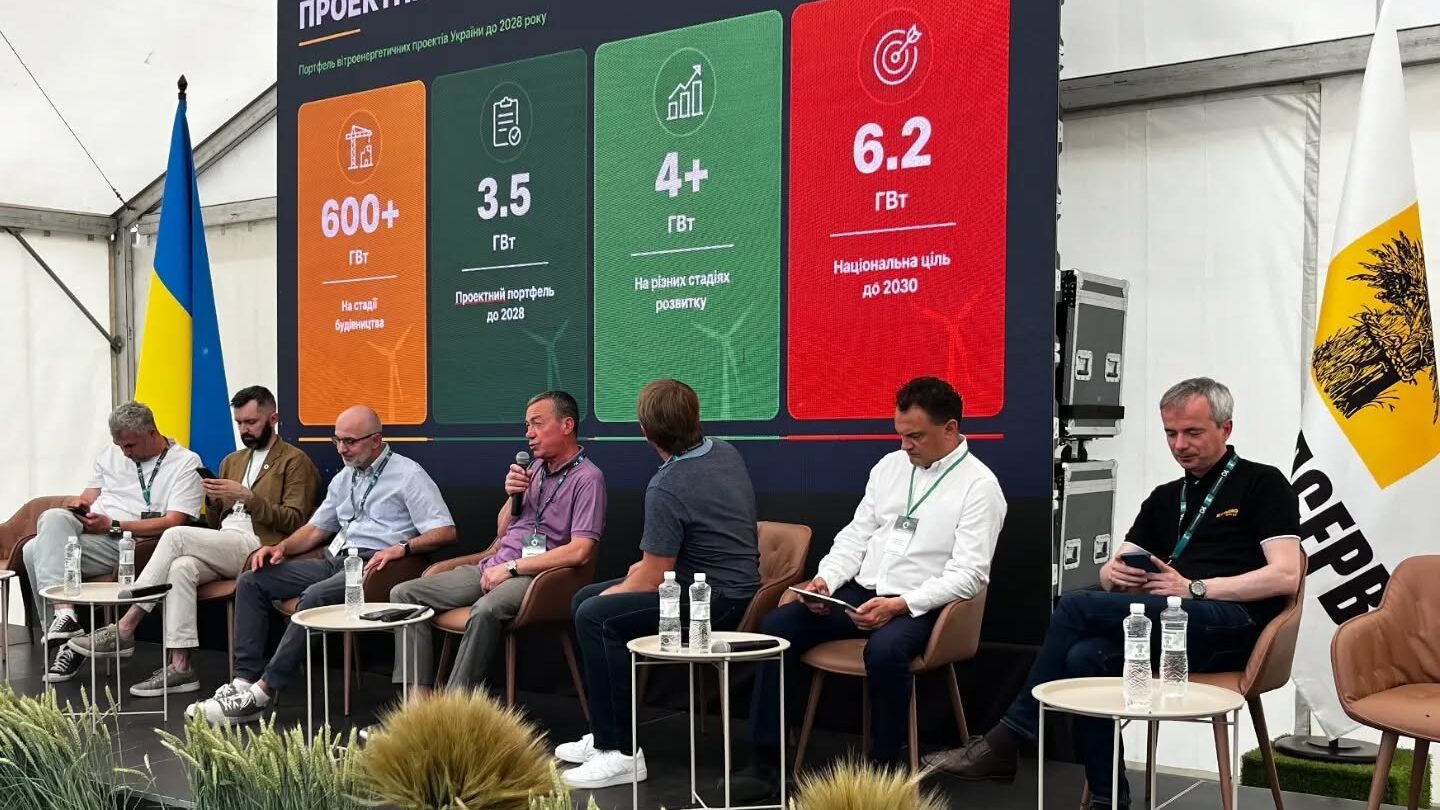
During the event, Mr. Savchuk presented the current state of the industry and a practical algorithm for the development of energy projects for business. According to the provided data, the total installed wind power capacity in Ukraine has reached 2.2 GW, including the 56% of capacities currently located in temporarily occupied territories. At the same time, the sector continues to grow: since 2022, 704 MW have been commissioned, of which a record 324.4 MW were launched in 2025, and the total project pipeline up to 2028 is estimated at 3.5 GW.
He also described in detail the stages of creating in-house generation for enterprises — from forming a concept and collecting data on peak and seasonal consumption to analyzing local constraints, demonstrating this with the example of assessing the wind potential of the “Zboriv” site. Special attention was paid to the model of energy microgrids, which involves the integration of wind power plants (WPPs), solar power plants (SPPs), biomass, and energy storage systems. This approach ensures not only a reliable energy supply and a reduction in the cost of agricultural products but also opens up additional opportunities for business: selling surplus electricity on the wholesale market, creating local “energy islands” for neighboring communities, and providing power system flexibility services to the Transmission System Operator (TSO).