

HYBRID Systems

Renewable energy sources require system balancing, since electricity generation from “green” power plants depends on sunlight and wind speed. Before russia’s full-scale invasion of Ukraine in 2022 and the resulting changes in the structure of the Unified Energy System, balancing of renewable generation in Ukraine was provided mainly by thermal power plants. This situation was referred to as the “green-coal paradox.” At the same time, the consequences of the large-scale war have prioritised the development of decentralised and renewable energy sources, which has, in turn, increased the need to address the issue of their system balancing.
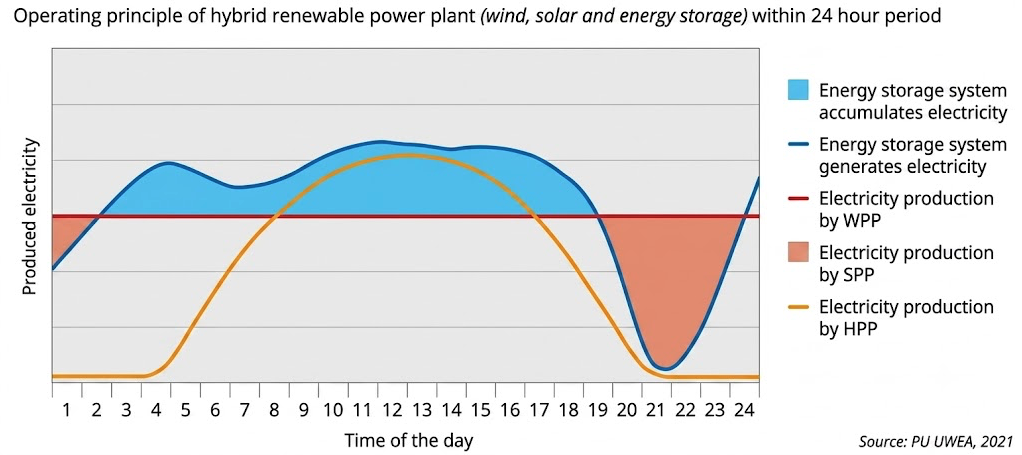
Nowadays, two main methods of balancing renewable energy generation are known worldwide, both of which are relevant for Ukraine’s development:
- through flexible (dispatchable) generation capacities
- through “green” hybrid power plants
Hybrid power plants are facilities that combine more than one type of electricity generation into a single integrated system.
According to research by the international engineering company AECOM, the combined or synchronous operation of multiple renewable energy sources can reduce capital expenditures by 3-13% and operating costs by 3-16%.
By integrating different types of generation such as solar power plants (SPP), wind power plants (WPP), and energy storage systems (ESS), hybrid power plants make it possible to compensate for fluctuations (“dips”) in the output of one generation source with another.
As a rule, energy storage systems are an essential component of such plants, as they increase overall reliability and, when needed, provide ancillary services to the power system, such as voltage regulation, balancing, and other stability functions.
Hybrid power plants are flexible in scale and can be built to supply electricity for small, medium, or large enterprises, as well as for regional or national power grids.
The development of the “green” hybrid power plant segment is strategically important for Ukraine’s energy system due to:
- ensuring the predictability and stability of renewable energy generation;
- increasing the flexibility and stability of the power system;
- reducing imbalance volumes;
- decreasing the number of system outages;
- ensuring continuous power supply to electrolyzers in green hydrogen production;
- improving project quality and economic efficiency.
UWEA closely cooperates with the relevant state authorities to create a legislative framework for the development of such a market segment as “green” hybrid power plants. In particular, it is necessary to: develop the appropriate regulatory and legal frameworks to define, in national legislation, different types of hybrid generating installations; standardize grid connection requirements, procedures for accounting of generated electricity, and the operation of hybrid power plants.
More about “green” hybrid systems from UWEA: https://epravda.com.ua/columns/2021/08/18/676977/
Last news
Membership and partnership









Members and partners of UWEA can be national and international companies and organizations that share the statutory goals and vision of the association, and are also ready to contribute to the development of the national wind energy market on the basis of honest partnership and mutual assistance.