There is a widespread myth in society that wind turbines pose a serious threat to birds, causing large-scale mortality. However, this claim does not hold up when examined against scientific evidence. However, this myth does not hold up to scrutiny based on facts and scientific data.
Since 2017, all wind energy projects in Ukraine that include two or more turbines, or where turbine height is 50 meters or more, are required to undergo an Environmental Impact Assessment (EIA). As part of this assessment, bird and bat migration routes are monitored for at least one year, and the potential impact of wind farms on wildlife is modelled. Based on these data, the construction and operation of wind farms are planned in a way that minimizes interactions between local fauna and wind energy installations.
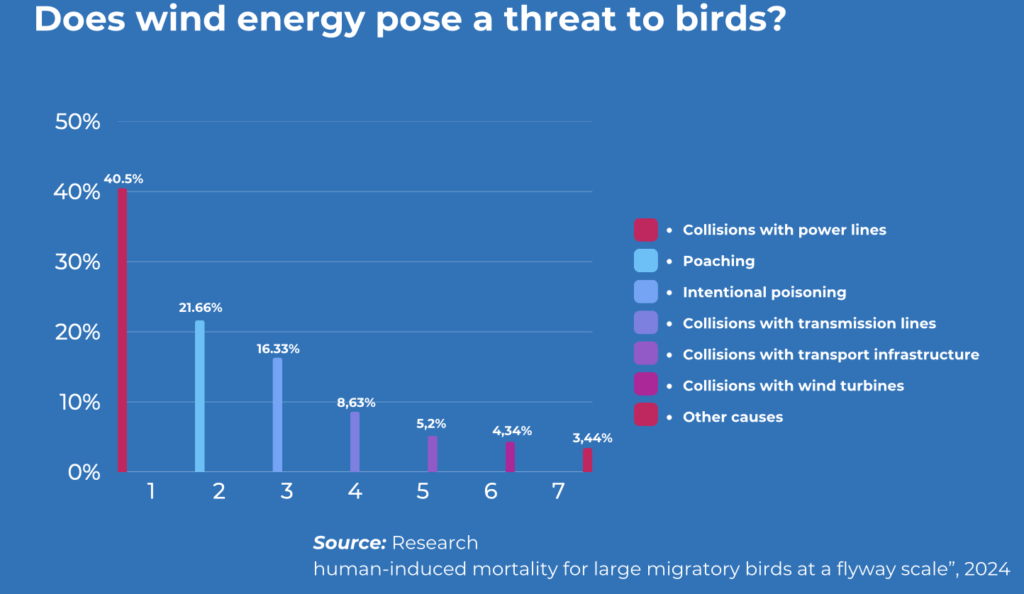
The impact of wind energy on birds should also be compared with other human activities. Numerous studies conducted worldwide, including in the United States – one of the global leaders in wind energy development – show that wind turbines are not the primary cause of bird mortality. For example, a 2024 study analysing data from 91 countries found that the main causes of migratory bird deaths are collisions with power lines (40.5%), poaching (21.66%), and intentional poisoning (16.33%). Collisions with wind turbines account for only 4.34% of fatalities, which is significantly lower than other anthropogenic factors.
These findings clearly indicate that while wind farms do have an impact on biodiversity, it is relatively small and can be effectively managed through proper planning, regulation, and site selection.