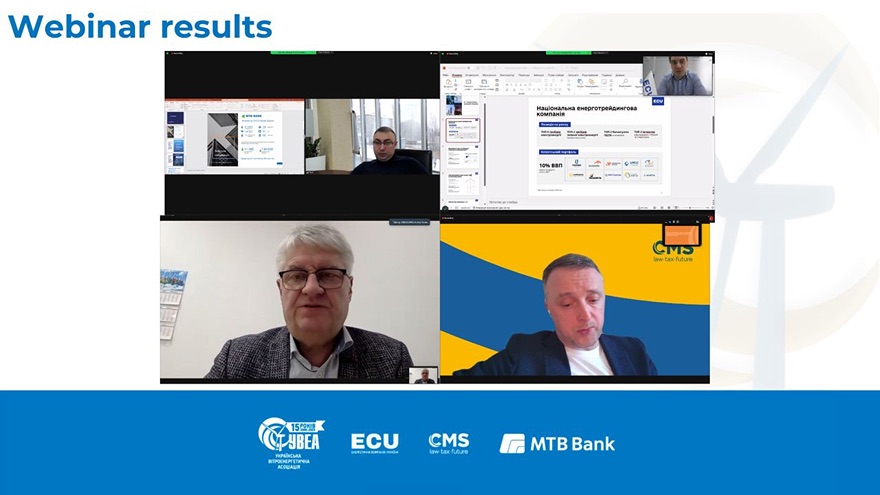
The 10+ most common challenges that renewable energy producers face when operating in the merchant power market was the topic of another UWEA webinar held on March 12, 2024. One of the most ground-breaking changes in the “green” energy industry of recent years has been the provision of the right for RES producers to leave the balancing group of the SE Guaranteed Buyer and conduct independent trading activities on the merchant power market. After more than six months of implementing these legislative initiatives, the UWEA has opted to discuss issues that frequently occur when companies switch to a new electricity trading format or are thinking about doing so. Representatives of such UWEA member companies as Illya Prytula, Head of Green Energy at Energy Company of Ukraine (ECU), and Vitaliy Radchenko, Managing Partner at CMS Cameron McKenna Nabarro Olswang, shared their experience and expert opinion during the online discussion. The guest speaker was Yuriy Artemenko, a member of the Supervisory Board of MTB Bank.
Opening the webinar, Andriy Konechenkov, Chairman of the UWEA Board and webinar’s moderator, said that the issue of enabling RES producers to leave the balancing group of the SE Guaranteed Buyer and conduct independent sales in different segments of the wholesale electricity market started back in 2020, while already in 2022, some solar power producers were among the first to start operating on a fully market-based basis. At the same time, the major driving force for wind electricity producers to enter the merchant market was the adoption of the Law of Ukraine No.3220-IX on Restoration and “Green” Transformation of the Energy System of Ukraine that provides for the temporary exit of the balancing group of the SE Guaranteed Buyer with the possibility to return and sell electricity at the same FiT rate as it was before leaving this balancing group. “As of January 2024, 78% of national wind power producers left the balancing group of SE Guaranteed Buyer, thereby ensuring the ability to cover its operating and financial costs during the war. The key reason for this decision was the desire to receive funds for the generated electricity promptly and in full,” Andriy Konechenkov noted.
Following Mr. Konechenkov’s remarks, Illya Prytula pointed out that collaboration with professional energy traders within PPAs enhances the benefits for RES producers that have entered the merchant power market.
“In recent times, the market has introduced several new opportunities to improve the operational efficiency of “green” energy producers. Now wind and solar power stations have access to the free market which allows them to receive immediate payments for their electricity and avoid accumulating debts. Collaborating with professional traders through Power Purchase Agreements (PPAs) simplifies the transition to a new operational model. ECU also offers contracts for green energy producers even at the design stage (pre-PPA), enabling investors to attract credit funds for building new capacities. Furthermore, a feed-in premium mechanism is being implemented in the market. This mechanism enables wind and solar power stations to operate in the merchant power market while still receiving state support”, – stated Mr Prytula.
Vitaliy Radchenko, in turn, spoke about the legal features of returning to the balancing group of the SE Guaranteed Buyer, the possibility of concluding long-term agreements for the purchase of “green” electricity, as well as the current status of guarantees of origin’s trading model in Ukraine.
“When switching from Feed-in Tariff to Feed-in Premium and leaving the balancing group of the Guaranteed Buyer, producers of electricity from RES must understand and carefully calculate in their financial models all of the obvious legal and financial risks associated with changing the support mechanism, balancing, the need to join a new balancing group with its own and special commercial conditions, and implicit risks – such as the consequences and high probability of increased curtailments of renewable energy production in case of such switch,” – stated Mr. Radchenko.
As a representative of the banking sector, Yuriy Artemenko examined whether it’s possible to leave the balancing group of the SE Guaranteed Buyer if it’s included in a loan agreement and what provisions should be contained in PPAs to receive loans for a new “green” project from the bank.
Although during the webinar, many advantages of doing business in the merchant power market were revealed, the UWEA member companies still face such market problems as indebtedness, lack of balancing capacities, difficult predictability of “green” generation, as well as poor regulation of the intraday market.