
 Authorization
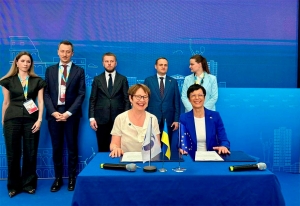
At the Ukraine Recovery Conference (URC2025), held on 10–11 July in Rome, Italy, a letter of intent was signed to establish the Ukraine Renewable Energy Risk Mitigation Mechanism (URMM) — a bold new initiative that could unlock €1.5 billion in investments for up to 1 GW of new renewable energy capacity. The mechanism is also designed to address one of the sector’s greatest hurdles: the risk associated with guaranteed power offtake.
What does this mean for Ukraine?
Following the large-scale destruction of Ukraine’s energy infrastructure caused by Russian attacks, the country faces an urgent need to restore and expand its generation capacity. The URMM is set to stimulate private-sector investment in renewable energy by ensuring revenue stability and mitigating key financial risks. At its core, the mechanism guarantees a minimum electricity price per project — giving banks and investors the confidence needed to support these ventures.
Who is behind this effort?
▪ The European Bank for Reconstruction and Development (EBRD) – responsible for structuring and channeling donor funding
▪ The European Union – through the Ukraine Investment Framework (UIF)
▪ The Government of the Netherlands
▪ The International Finance Corporation (IFC), the World Bank, and the Business Advisory Council of the Ukraine Donor Platform
▪ Industry associations including the Ukrainian Wind Energy Association (UWEA), the European-Ukrainian Energy Agency (EUEA), and Green Deal Ukraїna Project
Initial financial commitments include:
• €180 million from the European Union
• €12 million in grants from the Netherlands
Germany, Norway, Sweden, and Switzerland are also considering contributions.
How will the mechanism work?
Projects will be selected through transparent auctions. By stabilising long-term revenues, URMM reduces entry barriers for investors and developers, thereby accelerating the deployment of green energy. In parallel, targeted technical assistance will support the Ukrainian government in establishing a robust national support framework — ensuring the long-term viability of the renewable sector beyond the scope of the URMM.
Why is this critical now?
Ukraine holds vast renewable energy potential, yet market volatility has long discouraged private investment. The URMM has the potential to change this — restoring investor trust and catalysing a wave of new, clean energy projects. This initiative is also aligned with Ukraine’s broader EU accession reforms, serving as a pillar in the transition toward European energy and environmental standards.
“This platform is a testament to the power of collective advocacy,” said Andriy Konechenkov, Chairman of the Board of UWEA. “By reducing financial risk, we are unlocking the potential of renewable energy to drive both Ukraine’s recovery and its long-term resilience.”
The URMM is also a strategic milestone on the road to achieving the targets set in Ukraine’s National Energy and Climate Plan (NECP) for 2030, which positions renewable energy as a cornerstone of the country’s energy future.
We sincerely thank all our partners for their trust in the Ukrainian market, their strategic vision, and their unwavering commitment to action. The decisions we make today are building Ukraine’s energy independence for tomorrow.
Other EBRD initiatives announced at the URC include:
• UIF Financial Inclusion Programme: €200 million in guarantees to unlock €2 billion in SME lending
• SME Recovery Programme: €45 million to facilitate €135 million in financing for businesses
Since the start of the full-scale invasion, the EBRD has invested €7.2 billion in Ukraine and approved a €4 billion capital increase to sustain its commitment of around €1.5 billion per year, with the capacity to scale up further during the reconstruction phase.
Ukraine is rebuilding — through investment, reform, and clean energy. The time has come to shape an energy future free from threats and dependencies.

 Home
Home